Thank you very much for your continued interest in and support of the Nobeyama Radio Polarimeters (NoRP). We are writing to inform you of a major revision to the NoRP 1 GHz daily solar flux data for June and July from 1995 onward.
Monitoring observations of the solar microwave flux at 1 GHz began in 1951 at the Toyokawa campus of Nagoya University. In 1994, the antenna was relocated to the Nobeyama campus of the National Astronomical Observatory of Japan (NAOJ), where the long-term monitoring observations have continued. Recently, the 1 GHz solar flux has attracted increasing attention as a proxy for solar ultraviolet (UV) emission affecting the Earth's upper atmosphere. Against this background, a new solar microwave telescope, the Christoph-Latsch Teleskop (CLT), was constructed at the Geodetic Observatory Wettzell of the German Federal Agency for Cartography and Geodesy. Monitoring observations at 1--6 GHz began there in 2024.
Dr. Sebastian Mühlbauer of the German Federal Agency for Cartography and Geodesy informed us of a discrepancy between the 1 GHz daily fluxes measured by CLT and NoRP during June and July 2026. We investigated the discrepancy and found that it originated from an issue with the NoRP data. The immediate cause was anomalously high background values used in the flux calibration during June and July. These background measurements, which represent the radio power measured from "blank" sky, are referred to here as "sky values." The anomalous enhancement is shown in the figure below.
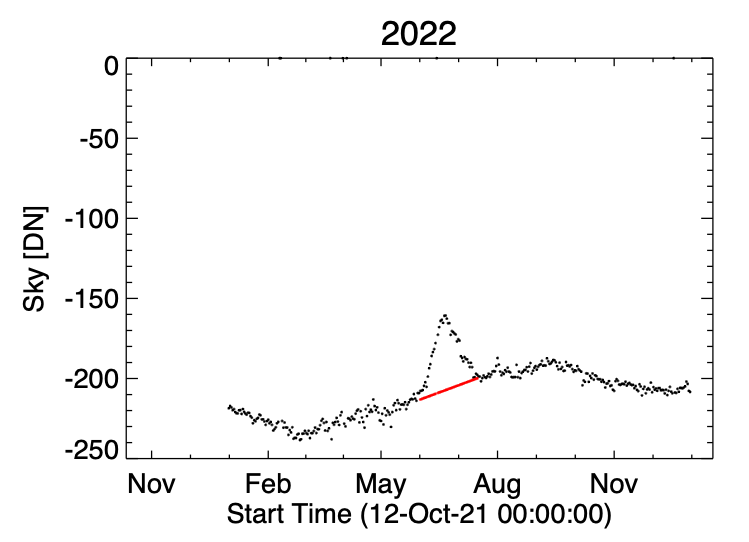
Seasonal variations of Sky values in 2022 (Black) and estimated values (Red)
The sky values for the NoRP 1, 2, and 9.4 GHz observations are measured by pointing the antennas 5 degrees away from the Sun along the declination axis. These measurements are made three times per day: in the morning (08:30 JST / 23:30 UT), around local noon at Nobeyama (11:30 JST / 02:30 UT), and in the afternoon (14:30 JST / 05:30 UT). The anomalous enhancements in the sky values are seen only at 1 GHz and are present in all three daily sky measurements. Unfortunately, our investigation also showed that this anomaly has occurred every June and July since 1994, when the antennas were relocated to Nobeyama. The root cause has not yet been conclusively identified. Further investigation is required to confirm this interpretation.
Although the root cause remains under investigation, in August 2026 we changed the position used for the sky measurement from a 5-degree offset from the Sun to a position near the zenith. This change is expected to prevent the same anomaly from affecting future observations.
Because the anomaly has been present since 1994, it was necessary to revise the affected 1 GHz daily flux data. Fortunately, the variation in the sky values outside June and July exhibit a stable seasonal pattern, allowing us to estimate the sky values for June and July by interpolation using measurements from May and August. The estimated values are shown by the red line in the figure above. This correction could not be applied reliably to several periods when the attenuation level for non-flaring periods was frequently adjusted (1994 and 2014) or when serious receiver problems occurred (2020 and 2021, a local oscillator issue). For the remaining affected periods, we used the estimated sky values for June and July to recalibrate the 1 GHz solar fluxes. The revised NoRP data were confirmed to be consistent with the independent 1 GHz flux measurements from the Christoph-Latsch Telescope (CLT). As a result of this recalibration, the following files in the NoRP database have been revised:
- Tables of calibrated daily solar flux
- Table of calibrated daily flux since 1951 (with 1 AU correction)
- FITS data files
The NoRP FITS files have also been updated because their headers contain the 1 GHz daily flux values.
The original files prior to the 1 GHz recalibration are preserved in the "bfr_1GHz_recal" directory under the corresponding URLs.
Although we believe that the recalibrated values provide a reliable correction to the affected data, the corrected sky values for June and July are based on interpolation. Therefore, the 1 GHz daily fluxes for these months have larger uncertainties than those for other months. Users should take this increased uncertainty into account when using NoRP 1 GHz daily flux data from June and July.
Finally, please note that the 1 GHz daily flux measurements obtained at Toyokawa have not been recalibrated because the historical sky-value data and detailed information on the sky-pointing positions are not available.